

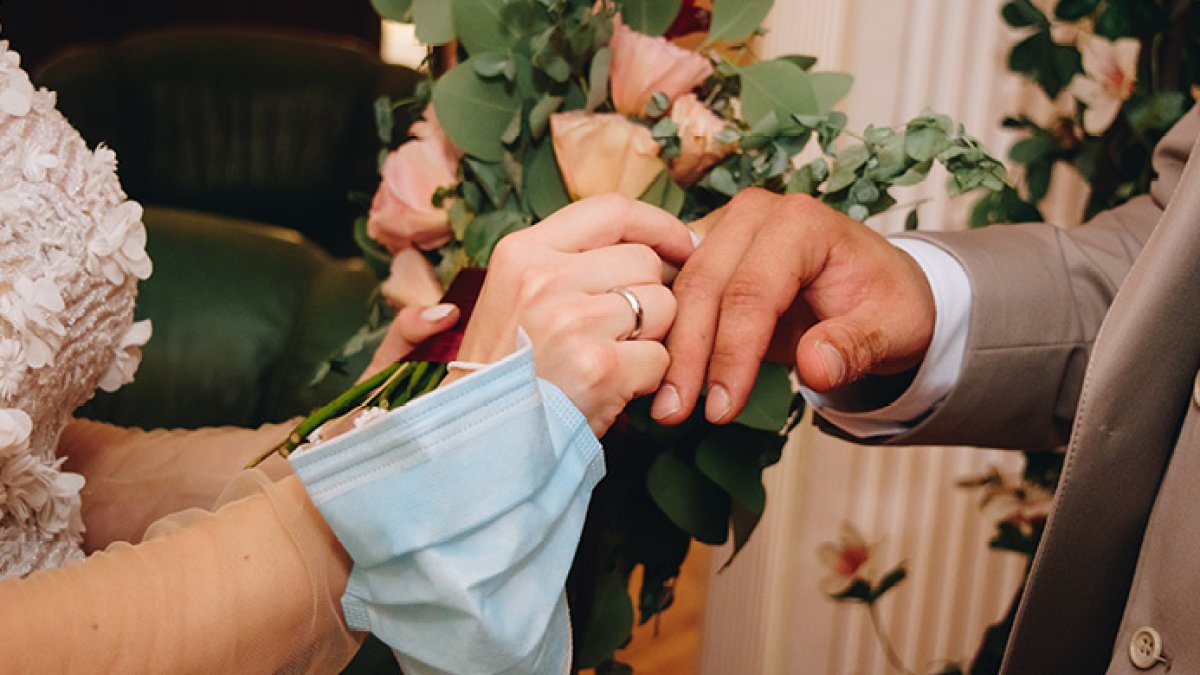

The graduation and wedding seasons are approaching and this year’s events will be one of a kind.
While most events were canceled or drastically reduced in the past year due to the coronavirus pandemic, broader vaccines and early signs of improvement in COVID metrics have allowed some jurisdictions to relax restrictions on face-to-face meetings.
What are the new restrictions when hosting a wedding, graduation ceremony, or other private social event this year? Here’s a look at what you need to know:
Capacity limits in Illinois, Cook County, and Chicago
All of Illinois is currently in Phase 4 of its reopening plan, with a limit on the number of people who can attend social events. These limits for indoor venues are 50% of the room capacity for up to 50 people and for outdoor venues 50% of the room capacity for a total of up to 100 people.
Chicago and Cook County, both of which previously had their own stricter restrictions, announced Thursday that they would be increasing capacity limits for these types of events to meet state guidelines.
As part of the statewide reopening plan, Illinois officials last month unveiled a new bridge phase and announced new metrics and guidelines that allow for higher capacity limits during a transition period between the current Phase 4 and a full reopening in Phase 5.
While the state has now reached the vaccination metrics needed to move from phase 4 to the bridge phase, the increase in COVID-19 cases and hospital stays have prevented the state from moving into the new phase.
Chicago officials said Thursday that Chicago, along with Illinois, will move into the bridging phase if the city’s reopening metrics “hold steady or continue to decline” for the next two weeks and the city meets state-set criteria.
As soon as the state moves into the bridging phase, the capacity limits nationwide will be increased to 250 for indoor events and to 500 for outdoor events. In phase 5 there are no capacity limits.
Vaccinated people do not count towards capacity limits
People fully vaccinated against COVID-19 will no longer count towards capacity restrictions at private events such as weddings and parties in Chicago and the suburb of Cook County, officials said Thursday.
The change brings both jurisdictions in line with the updated Illinois Health Department Phase 4 guidelines presented last month.
When Illinois officials updated the state’s reopening schedule in March, they said “Individuals with evidence of full vaccination or a negative COVID-19 test (PCR) will not count toward capacity limits 1-3 days prior to an event or excursion “.
According to official figures, people are fully vaccinated 14 days after receiving their final vaccine dose.
In Chicago, events to apply these new guidelines must be held at a licensed company, may not be open to the public, and guests are required to report in advance of the event, city officials said. The city’s website also states that events where vaccinated people do not count towards capacity limits must be held in specific venues. “That means a restaurant cannot rent out its regular restaurant area for an event.”
Business owners will be responsible for verifying that exempt guests are fully vaccinated and keeping records, Mayor Lori Lightfoot’s office said, adding that the city “will consider extending this exemption to other industries in the coming weeks, provided that our COVID-19 metrics will continue to improve. “
Other guidelines on social events
Chicago and Cook County released additional event space guidelines in Phase 4.
In Cook County, other restrictions on social events and gatherings include:
- At an indoor social event or gathering, the group for the specific social event may not be able to be divided into multiple rooms.
- At an outdoor social event or gathering, multiple tents must not be placed 30 feet apart to accommodate multiple groups of 100 people for the group of the particular event.
- All venues must keep dance floors and rooms closed.
- The size of the inner table is limited to a maximum of six people.
- The table size outside is limited to a maximum of 10 people
In Chicago, some of the massive new requirements and recommendations for event space, primarily aimed at businesses hired to host this type of event, include:
- Make sure there are> 6 feet between people and close the throttles
- Arrange the tables so that the seats are at least 6 feet apart. Take the tables out of service and / or add physical barriers (e.g. plexiglass) between the tables if they cannot be moved
- Use impermeable barriers that prevent 6-foot social distancing (e.g., event check-in counters, registers).
- Clearly mark all areas where guests are queuing (e.g., check stands and terminals, bars and buffets, restrooms, etc.) with appropriate guidance on physical distancing
- Make sure the stage or other designated area for performers (e.g. dancers, singers, bands) is at least 10 feet from the audience
- Limit the number of guests
- Several groups / events are permitted in the same location if groups meet in separate rooms and do not interact (e.g. convention centers with several event rooms).
- It is recommended that guests mainly sit and carry stationery (e.g., sit at tables) throughout the event.
- Nearby areas where individuals gather in close proximity (e.g. dance floors)
- Whenever possible, limit the interactions between performers (e.g. dancers, singers, bands) and guests
- Make sure employees or salespeople and guests wear protective clothing
- Implement common disinfection requirements for all high contact surfaces / items
- Make sure that providers / performers disinfect all devices (e.g. microphones, instruments, photo booths) before and after each use
- If possible, provide disposable items and equipment (e.g. menus, containers, condiments, linens).
- Clean and disinfect non-disposable items / devices (e.g. containers, jugs, tables, chairs, bed linen) after each use. Notice that the article has been cleaned up for the next user
- Use fixed menu boards or digital menus whenever possible
- Change working conditions to minimize interactions
- All guests must be seated while eating or drinking
- Counter / bar seating is allowed if there is a 6-foot gap between guests (plexiglass should be used between guests and bartenders).
- Need organized management when ordering from the counter / bar but better wait
- If this is feasible, consider making changes to the venue to encourage social distancing (e.g. moving furniture, marking floors, and / or realigning workspaces so staff can turn away from each other).
- Have cafeterias, buffets, or other self-service stations reopen when an employee or salesperson is serving the food and wearing the correct PPE
- If possible, limit the use of beverage stations by guests
- If practicable, set up directional corridors, doors, or passageways for pedestrian traffic
- If practicable, provide separate toilets for workers and guests / third parties
- Make sure that the music volume remains low so that employees or salespeople and guests can practice social distancing during the conversation (e.g. taking orders).
- If this is practical, recommend cashless / contactless ordering and payment (e.g. for “cash” bars).