


Consumers are braving the worst May weather recorded last week to make the most of the grand reopening of UK pubs and restaurants indoors. This suggests that a continued spike in spending could help the UK economy recover faster than expected.
Analysis of unofficial data shows that after months of lockdown, the populations of England, Scotland and Wales returned to their favorite bars and restaurants when they opened inside from May 17, bringing bookings and sales to pre-pandemic levels were.
The numbers showed a faster recovery than they did after reopening after the initial lockdown last year, and are better than expected building on last week’s economic data. The recent phase of easing coronavirus restrictions also helped boost the tourism sector. Despite the heavy rains, there were even indications of an associated increase in retailers.
Consumer spending is rising
UK consumer spending between Monday and Wednesday last week rose 10 percent to levels seen on the same days in 2019 before the pandemic. This was the strongest reading in weeks since coronavirus restrictions were introduced in the UK last March. This comes from figures from Fable Data, which tracks banking operations.
“It looks like the recovery in activity may be even faster than expected,” said Kieran Tompkins, an economist with Capital Economics.
Nick Fullbrook, manager of the Tiger’s Eye restaurant in Gloucester, said that despite the bad weather, they “had a steady flow of customers during the week and then increased over the weekend”.
According to Tenzo, an analytics and sales forecasting app, sales at restaurants, cafes, pubs and takeaways on Saturday increased 36 percent from the same day in 2019. Christian Mouysset, CEO of Tenzo, said the recovery was “far higher as “We imagined that. ”
Fable reported restaurant and pub spending up 19 percent between Monday and Wednesday over the same period in 2019. Barclaycard reported that pub and bar spending last week was up 7 percent compared to the same week in 2019 have increased and also fell sharply, spending on cinemas and bowling alleys.
Diners flock to restaurants
According to Open Table, restaurant bookings on Friday and Saturday last week were 65 percent higher than on the same days in 2019. Last year, bookings only recovered above 2019 levels in August, when the state subsidy system ” Eat Out to Help Out ”.

Yael Selfin, chief economist at consulting firm KPMG, said the latest data “shows that consumers have embraced the new freedom they have been given, particularly with regard to social activities.”
Tourism outside of London is getting a boost
The tourism sector also received a boost, according to data from AirDNA, a company that tracks bookings on sites like AirB & B and VrBo. In anticipation of the recreational sector re-opening, short-term rental futures contracts in the UK closed the gap almost the same week in 2019 for the week ending May 15, and rose above pre-pandemic levels in many regions, including Wales and the US, in the Southwest.
Mark Cole, owner of Brindleys, a luxury B&B townhouse in Bath, a popular tourist destination in the west of England, said they were fully booked despite the lack of international tourism. He added that this year’s reopening on May 17 is “a lot better” than the first easing relief last year.

However, short-term rental bookings in London were still 65 percent lower than before the pandemic, due to the lack of corporate events and international visitors.
Retail more subdued
The reopening of indoor leisure also gave a much-needed boost to retailers who opened their doors in England despite the inclement weather.
“The reopening of the indoor restaurant on Monday last week certainly helped UK retail destinations gain a foothold for much of the week in the face of persistent and often heavy rain across most of the week,” said Diane Wehrle of retail consultancy Springboard .
The visitor data showed that in the week leading up to May 22nd, the number of buyers increased by 1 percent compared to the previous week. However, compared to the same week in 2019 when the weather was dry and sunny, the numbers were down almost 30 percent.
Similarly, Google’s retail and entertainment mobility data showed that visitor numbers were at their highest level since early fall last week, but below pre-pandemic levels.
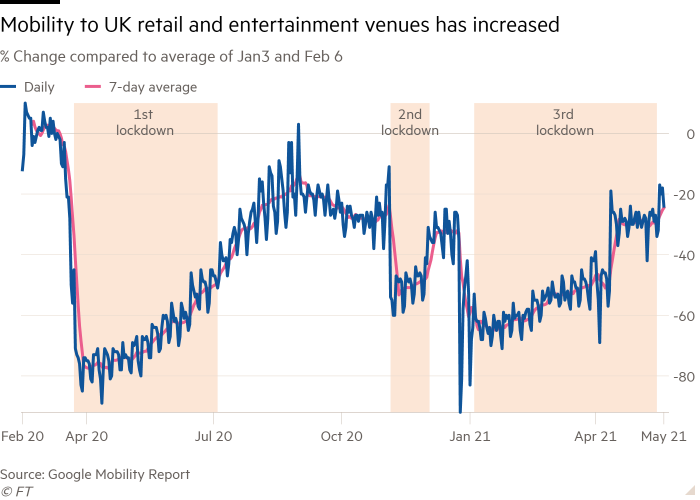
The growth trends inferred from the different datasets were different and reflected the way in which they were obtained. They are also less comprehensive than official figures, but economists use the unofficial channels because they provide earlier indications of likely trends than standard economic data.
Andrew Goodwin, UK chief economist at Oxford Economics, said the data showed the recovery had “moved into another gear” after accelerating sharply after the initial easing of restrictions in mid-April. He predicts GDP growth of 6 percent in the second quarter, but said recent positive signals made him consider a possible upward revision of “our forecasts that are already well above consensus”.